


Masseto: The "Pétrus of Italy" and the Apex of Wine Speculation
Liquid insights on Italy’s finest Merlot, the mathematics of scarcity, and compounding alternative wealth.
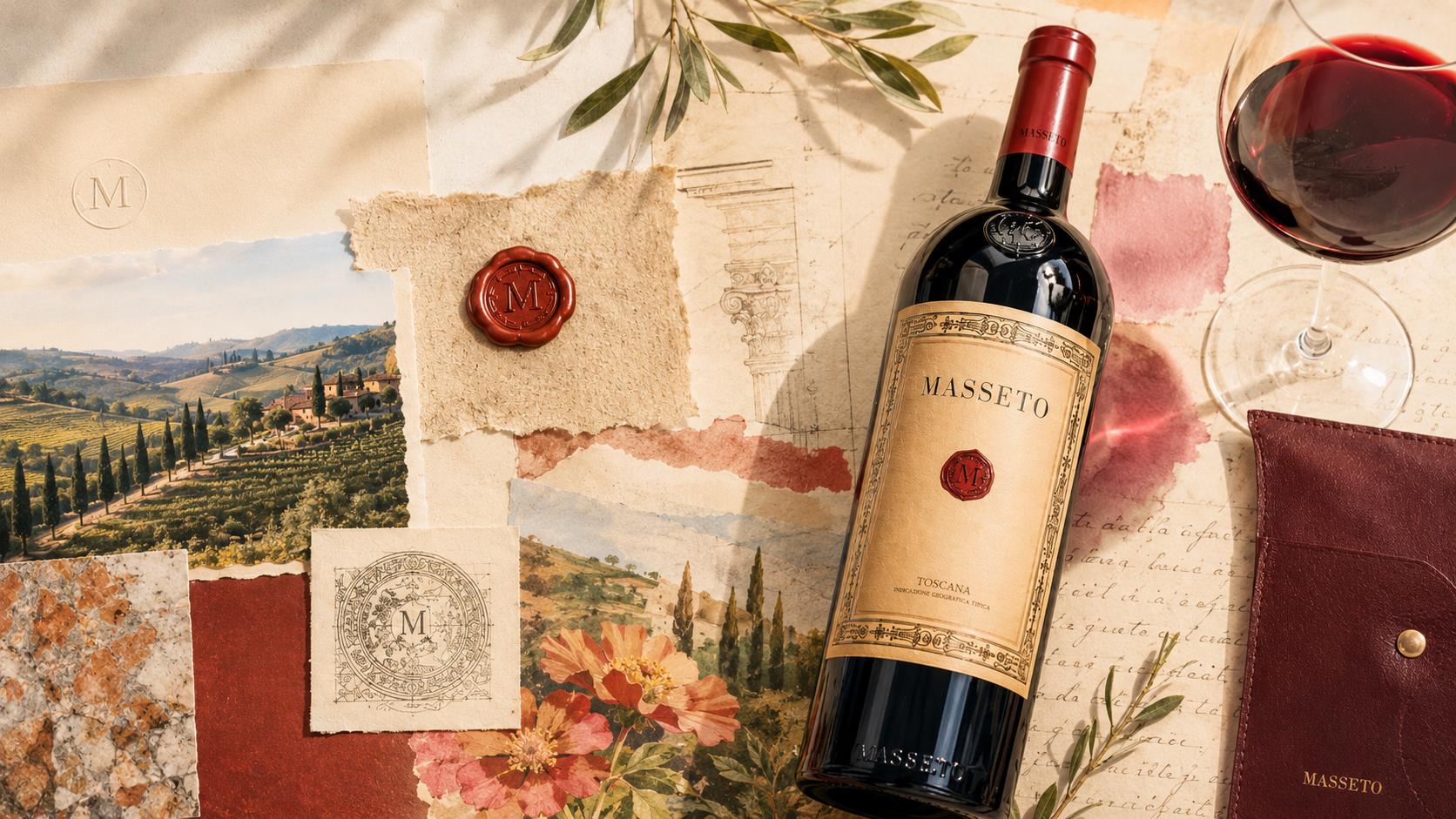
This edition examines a single asset class through four lenses: origin, macroeconomics, mathematical returns, and auction market behaviour. The through-line is a thesis the data supports without equivocation. Masseto is not merely the finest Italian Merlot. It is the most structurally sound speculative wine asset in the world, and the numbers make the case better than any cellar note ever could.
In 1981, Ludovico Antinori founded Tenuta dell'Ornellaia on the Bolgheri coast. Five years later, his winemakers identified something unusual beneath a small section of hillside: veins of Pliocene marine blue clay, dense and mineral-rich, locally called "massi." The 1986 decision to vinify the fruit from that plot as a standalone 100% Merlot was, by any measure, an agronomic experiment. What followed was something closer to a corporate event. The wine's success was so structurally distinct from the Cabernet-dominant Bolgheri DOC blends around it that the Marchesi Frescobaldi family, who now own the property, eventually carved Masseto out entirely. Today it operates as a fully autonomous corporate entity, with its own dedicated cellar cut into the hillside. The experiment became the institution.
That separation matters to investors. Masseto's independence is not a branding exercise. It is an acknowledgement that the asset behaves differently from everything around it, and should be governed accordingly.
Roughly 2,500 cases leave the estate each year. That is 30,000 to 32,000 bottles distributed across a global collector base that spans Hong Kong, New York, Geneva, and every serious auction room in between. Set that production figure against a First Growth like Mouton Rothschild, which produces closer to 25,000 cases annually, and the supply arithmetic becomes stark. Masseto operates at one-tenth the volume in a market of comparable, and in some respects greater, demand intensity.
The pricing reflects this directly. The 2019 vintage traded at between €900 and €1,000 per bottle. The 2021 released at €600 ex-négociant, a figure that already positions it above virtually every other Italian wine at release. An aggregated analysis of active vintages from 2006 to 2015 shows an average total return of 48.7% over five-year holding periods, a CAGR of 7%. That is a credible, repeatable number, not a single-vintage anomaly. The counterargument, that fine wine CAGRs are flattered by survivorship bias as consumed bottles exit the market, is worth acknowledging. It is also, in Masseto's case, an argument in favour of holding. Consumption tightens supply further, which is precisely why the 2004 vintage, awarded 100 points by Antonio Galloni, has sustained an 11% average annual return over the last five years and rarely trades below €925 per bottle globally. Scarcity that was structural at release becomes absolute over time.
Sotheby's, Christie's, and Pandolfini have each provided the same answer to the same question: does the secondary market believe the thesis? Near-zero unsold rates and consistent hammer prices above high estimates are the response. In April 2023, Sotheby's auctioned 132 bottles sourced directly from the Ornellaia caveau. The lots cleared at an estimated €200,000. That is not simply a price. It is a quantification of provenance premium, the additional capital the market assigns to bottles whose chain of custody is unimpeachable. Ex-château certification is, in portfolio terms, the equivalent of a clean title on a piece of prime real estate.
The 2021 vintage adds a forward dimension. Antonio Galloni awarded it 100 points. James Suckling gave 98. Wine Advocate contributed 95. The weighted average across those three sits at 97.7 out of 100, and the ideal drinking window does not open until 2027, extending well past 2050. A collector acquiring the 2021 today at €600 is, in effect, purchasing a long-duration asset whose revaluation trigger has not yet arrived.
Masseto's position at the speculative apex of Italian wine is not a matter of taste. It is a function of 32,000 bottles, a 7% floor return, an auction market that refuses to leave lots unsold, and a provenance structure that rewards patience with compound precision. The blue clay was the beginning. The balance sheet is what it became.


