


Capital Preservation and Premium Yields in Val d'Orcia: A Trophy Asset Review
Techniques for crafting authentic messages that resonate in automated times.
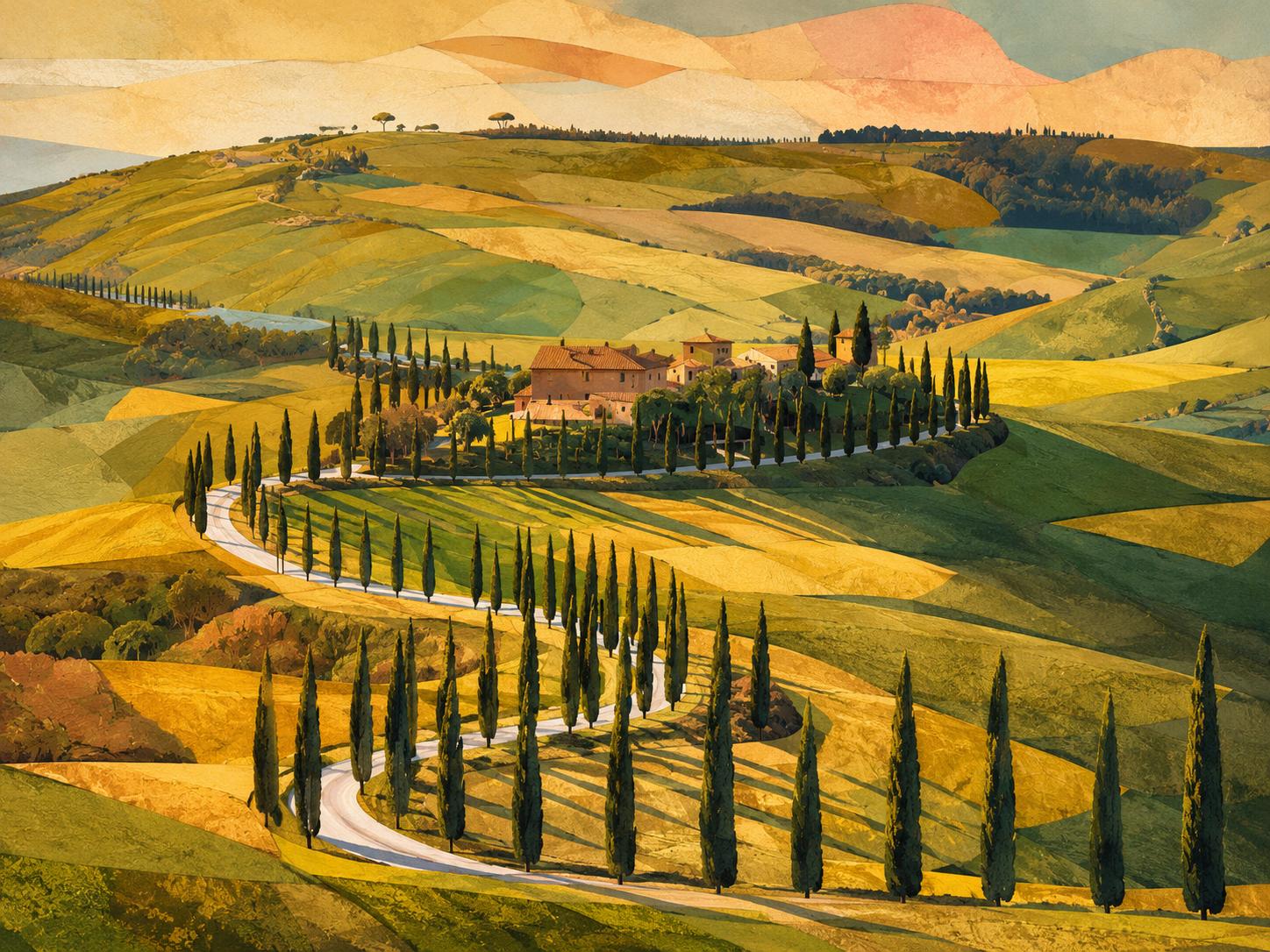
Stand on any ridge between Pienza and San Quirico d'Orcia on a clear morning and the view has not materially changed since Ambrogio Lorenzetti painted his idealised Tuscan countryside in the fourteenth century. The cypress-lined roads, the pale clay hillsides, the isolated farmhouses sitting at the crown of low hills: the composition is deliberate, protected, and by legal design, finite. That is not a romantic observation. It is the structural argument for why property in this valley holds its value the way it does.
The thesis is straightforward. Val d'Orcia's UNESCO World Heritage landscape designation does not merely protect scenery; it functions as a hard cap on developable land. Combined with sustained international demand and a short-term rental market that performs well in the Tuscan high season, qualifying assets here offer a defensible long-term store of capital. A villa currently listed by Romolini at €3,950,000, complete with a swimming pool, illustrates the category well.
UNESCO designation changes the arithmetic of supply in a way that planning restrictions alone rarely achieve. Most protected zones carry guidelines; Val d'Orcia carries a designation tied to the visual integrity of the entire landscape, meaning that new construction which alters the character of the valley is not simply difficult to permit, it is structurally incompatible with the terms of the designation. The number of quality estates in the valley is, in practical terms, fixed.
This matters because the demand side of the equation is not fixed. International buyers, particularly from Northern Europe, the United States, and increasingly the Gulf, have treated southern Tuscany as a reference market for European trophy real estate for several decades. When the supply of qualifying assets is capped and the buyer pool continues to broaden, the conditions for capital preservation are more durable than in markets where new development can absorb demand and dilute scarcity.
The Romolini listing at €3,950,000 sits within this constrained supply. It is not the price alone that defines the asset class; it is the combination of price, location, and the regulatory framework that makes replication of the asset functionally impossible.
The honest counterargument to any Val d'Orcia acquisition is straightforward: liquidity is low and holding horizons are long. This is not a market where an investor can reposition quickly. Transaction costs in Italian real estate are material, the buyer pool for assets at this price point is narrower than in liquid urban markets, and the process of selling a rural Tuscan estate is measured in months, not weeks.
What the short-term rental market provides is not a solution to that illiquidity, but a mechanism for carrying the asset through a long hold without the full cost of ownership falling entirely on the balance sheet. Val d'Orcia draws consistent international visitor traffic during the Tuscan high season, and villas of this category, with pools and the landscape setting that the designation protects, command premium nightly rates from the segment of travellers who treat a week in southern Tuscany as a considered choice rather than a default holiday. That income does not guarantee a return, and no projection of future rental yields belongs in a rigorous analysis without supporting data. What can be said is that the asset class has structural characteristics, scarcity, international name recognition, and a defined high-demand season, that support rental performance as a reasonable expectation rather than a speculative one.
Investors accustomed to liquid asset classes sometimes treat long holding horizons as a disadvantage to be overcome. In the context of Val d'Orcia trophy real estate, the holding horizon is better understood as the price of admission to a category that derives much of its preservation quality from precisely that illiquidity. The assets that hold value here are the ones that rarely come to market. When they do, the asking price reflects accumulated scarcity.
The Romolini listing at €3,950,000 is not a short-term trade. It is a long-duration position in a landscape that has been legally insulated from the development pressures that erode value elsewhere. For a wealthy international investor whose primary concern is capital preservation across a multi-decade horizon, with income generation as a secondary objective, the structural logic of the category is coherent.
Lorenzetti's hills have outlasted every short-term market cycle they have witnessed. The designation that now protects them is a more formal version of what was always true: some landscapes are simply not available for reinvention.


