The Contemporary Fiefdom: Land Banking and Hybrid Asset Strategy in the Sienese Countryside
Smart tools and routines to help freelancers stay organized, inspired, and productive.
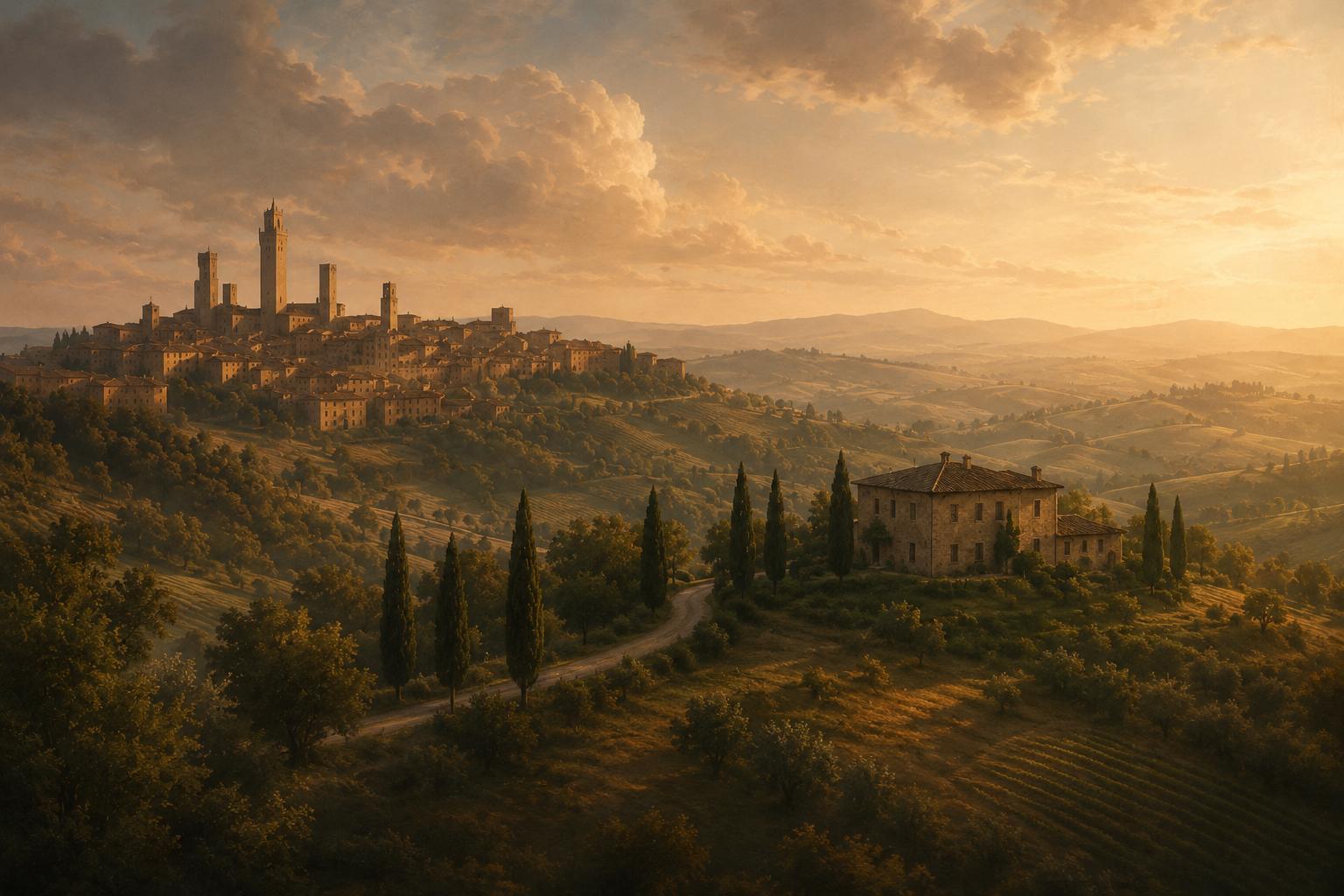
Six hundred and thirty-five hectares. Twenty thousand square metres of built volume. Two private lakes. A medieval hamlet with its original stone quarters, olive oil mills, farmhouses, and warehouses still standing and still operational, a few kilometres from Siena in the Rapolano Terme area. Before any conversation about price, revenue models, or regulatory moats, the sheer arithmetic of this asset demands a pause.
The thesis is straightforward: at €38 million, this property is not priced as a residence. It is priced as a territorial holding, and the comparison class is not the villa market. It is sovereign land. The counterargument, predictably, is that €38 million represents a substantial capital commitment for a single illiquid asset in a single jurisdiction. That argument collapses the moment you understand what Italian planning law now makes permanently impossible to replicate.
Italy's current urban planning framework, built on decades of increasingly restrictive landscape constraints and heritage protection codes, does not permit the assembly of a historical cluster of this scale from scratch. It cannot be done. A buyer today cannot acquire 635 hectares of Sienese countryside, construct 20,000 square metres of built volume, and obtain the permits to operate it as a unified estate. The regulatory environment simply will not allow it.
This is the foundational investment case. The asset exists because it was built across centuries, before the protective legislation that now makes it irreplaceable. The 520 hectares of forest, the two private lakes covering 6 hectares of surface area, the residential structures and ancient quarters, all of it sits behind a wall that no amount of capital can breach from the outside. For an institutional buyer or a family office seeking a non-replicable store of value, that wall is the asset. The medieval stonework is incidental.
At €38 million, the implied cost per hectare of land alone is approximately €59,800. For a self-contained, legally protected territory in one of Europe's most scrutinised agricultural and heritage zones, that figure reflects the floor, not the ceiling.
The 635 hectares are not decorative. The land is already structured for independent agricultural operation, which matters enormously to family offices deploying hybrid estate models.
The vineyard portfolio runs to 25 hectares, with production including Chianti Classico and IGT designations. The olive groves cover 10 hectares. Arable land accounts for 80 hectares, of which 35 hectares are dedicated to premium organic orchards and cereals. These are not aspirational figures; they are operational ones. The estate functions now, which means a buyer acquires productive yield from day one rather than absorbing a development timeline.
The albergo diffuso model, the scattered boutique resort format in which individual buildings across a hamlet operate as a unified hospitality product, is precisely the typology for which this asset is physically configured. The dispersed stone buildings, the warehouses capable of conversion, the olive oil mill, the ancient quarters: these are the building blocks of a high-yield hospitality operation that carries none of the architectural homogeneity of a conventional hotel. The 520 hectares of forest and the private lakes function as a privacy buffer that cannot be monetised on a spreadsheet but carries real value in a market where genuine seclusion has become the scarcest amenity of all.
For a family office, the combination is coherent: Chianti Classico production with a recognised DOC designation, precision oliviculture, organic arable land, and a hospitality vehicle, all operating within a single, self-sufficient territorial unit. Each revenue stream hedges the others. Agricultural income is not correlated with hospitality occupancy rates. Both are largely insulated from the external development pressures that affect conventional real estate.
The asking price needs to be read against what it delivers: full ownership of an entire historical village, 20,000 square metres of built space across residential structures, warehouses, farmhouses, an olive oil mill, and ancient quarters, all set within 635 hectares that include productive vineyards, olive groves, arable land, pristine forest, and two private lakes.
There is no planning application that replicates this. There is no land assembly strategy that produces it. There is no construction programme that recreates it. The asset exists in its current form because history created it before the regulatory environment closed the door.
For the buyer who understands that the rarest assets are the ones that cannot be manufactured, the arithmetic is not complicated.